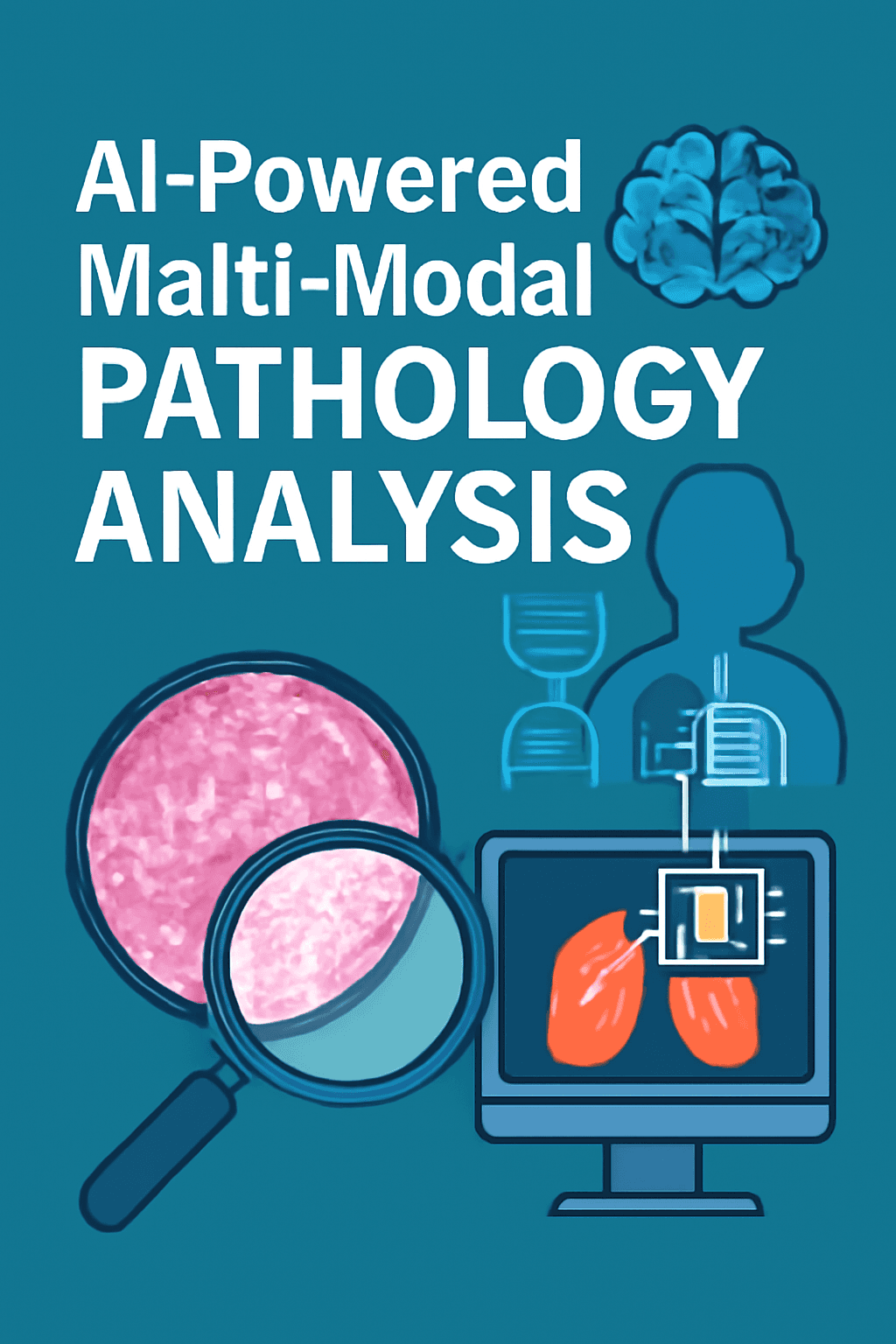
AI-Powered Multi-Modal Pathology Analysis
Live Registration
BATCH #24
03Seats Left
92% Booked
Registration Closed
Course Overview
Program Syllabus
Module 1
About This Course
Pathology is a crucial component in diagnosing diseases such as cancer, cardiovascular conditions, and neurodegenerative disorders. Traditional pathology relies heavily on visual examination of histopathology slides, but the increasing availability of multi-modal data (such as imaging, genomics, and clinical records) has opened the door for more advanced, AI-driven analysis.
This workshop will delve into the application of artificial intelligence for integrating multi-modal data to enhance diagnostic workflows in pathology. Participants will explore how AI models can combine imaging data (e.g., digital slides, radiology), molecular data (e.g., genomics, transcriptomics), and clinical patient data to provide more comprehensive, accurate, and actionable insights. The workshop will also cover real-world case studies demonstrating the successful implementation of AI in multi-modal pathology.
Module 2
Aim
This workshop aims to explore the integration of AI technologies in multi-modal pathology analysis, focusing on the combination of imaging, molecular data, and patient records to enhance diagnostic accuracy. Participants will learn how AI models can merge data from various modalities to improve disease detection, prognosis, and treatment planning in pathology.
Module 3
Workshop Objectives
- Understand the basics of multi-modal data types in pathology (imaging, molecular data, clinical records).
- Learn how AI models can integrate and analyze diverse data sources for enhanced pathology diagnosis.
- Gain hands-on experience with AI tools for processing and analyzing multi-modal pathology data.
- Explore the application of deep learning techniques for pathology image analysis and integration with molecular data.
- Understand the challenges and opportunities of implementing AI in multi-modal pathology analysis in clinical practice.
Module 4
Day 1 – Introduction to Multi-Modal Pathology & AI Fundamentals
- Overview of pathology and its role in disease diagnosis
- Introduction to multi-modal data: histopathology images, genomics, and clinical data
- Fundamentals of AI, machine learning, and deep learning in healthcare
- Case studies: Applications of AI in single-modality pathology
- Hands-on session: Loading and visualizing pathology datasets
Module 5
Day 2 – AI Techniques for Multi-Modal Data Integration
- Data preprocessing and normalization across modalities
- Feature extraction from images, molecular, and clinical datasets
- Deep learning models for multi-modal analysis (CNNs, autoencoders, multimodal fusion techniques)
- Integration of genomic, imaging, and clinical data using AI pipelines
- Hands-on session: Training a multi-modal AI model for tissue classification or disease prediction
- Discussion: Challenges in multi-modal data integration and solutions
Module 6
Day 3 – Applications & Translational Insights
- Predictive modeling for disease prognosis using integrated data
- AI-assisted cancer detection and biomarker identification
- Evaluation metrics and model interpretability for multi-modal AI
- Clinical relevance: Translating AI models to pathology practice
- Capstone exercise: End-to-end multi-modal pathology analysis workflow
- Future directions: AI in precision medicine, digital pathology, and personalized healthcare
Module 7
Who Should Enrol?
- Undergraduate/Postgraduate Degree in Computer Science, Biomedical Engineering, Bioinformatics, Medical Imaging, or related fields.
- Professionals in pathology, medical imaging, healthcare IT, and AI-driven healthcare solutions.
- Data Scientists and AI Engineers interested in applying AI to healthcare and multi-modal data analysis.
- Individuals interested in exploring the application of AI in improving pathology diagnostics and clinical decision-making.
Module 8
Important Dates
Module 9
Registration Ends
11/28/2025
IST 7:00 PM
Module 10
Workshop Dates
11/28/2025 – 11/30/2025
IST 8:00 PM
Module 11
Workshop Outcomes
- Multi-Modal Data Integration: Learn how to combine various data types (imaging, molecular, and clinical) into a unified AI model for pathology.
- Hands-on Experience: Gain practical skills in processing and analyzing multi-modal pathology datasets using AI techniques.
- AI-Based Diagnostic Tools: Develop the ability to build and evaluate AI models for pathology diagnosis.
- Pathology Workflow Optimization: Understand how AI can streamline pathology workflows and improve diagnostic accuracy.
- Real-World Application: Learn how AI is already being applied in multi-modal pathology analysis with real-world case studies.
Module 12
Fee Structure
Module 13
Student Fee
₹1499 | $55
Module 14
Ph.D. Scholar / Researcher Fee
₹2499 | $65
Module 15
Academician / Faculty Fee
₹3499 | $80
Module 16
Industry Professional Fee
₹4499 | $90
Module 17
What You’ll Gain
- Live & recorded sessions
- e-Certificate upon completion
- Post-workshop query support
- Hands-on learning experience
Module 18
Join Our Hall of Fame!
Take your research to the next level with NanoSchool.
Module 19
Publication Opportunity
Get published in a prestigious open-access journal.
Module 20
Centre of Excellence
Become part of an elite research community.
Module 21
Networking & Learning
Connect with global researchers and mentors.
Module 22
Global Recognition
Worth ₹20,000 / $1,000 in academic value.
Module 23
View All Feedbacks →
Need Help?
We’re here for you!
★★★★★
Scientific Paper Writing: Tools and AI for Efficient and Effective Research Communication
DEEPIKA R • ★★★★★
AI for Psychological and Behavioral Analysis
Dr srilatha Ande srilatha.ammu12@gmail.com • ★★★★★
Prediction of Protein Structure Using AlphaFold: An Artificial Intelligence (AI) Program
Purushotham R V • ★★★★★
AI and Ethics: Governance and Regulation
Yaqoob Al-Slais • View All Feedbacks →

Lead Instructor
Dr. Sarah Chen
PhD in Computational Mechanics from MIT with 15+ years of experience in Industrial AI. Former Lead Data Scientist at Tesla and current advisor to Fortune 500 manufacturing firms.
Limited SeatsClosing Soon
AI-Powered Multi-Modal Pathology Analysis
Professional Certification Program
🎥
FormatLive + Recorded
📅
Duration8 Weeks
📜
CertificationVerified
Enroll Now
Instant Access
Need Guidance?
Not sure if this course is right for you? Schedule a free 15-minute consultation with our academic advisors.